
The short answer
SDOH data becomes usable when it lives in one source of truth, mapped at the community level, so teams spend their hours acting on needs instead of wrangling files.
That is the idea behind SDOH Solutions, a cloud-based social determinants of health platform. This post covers why scattered SDOH data slows population health teams down, what a single source of truth looks like in practice, and how to measure whether it is working.
It follows our recent LinkedIn poll, “Where does most of your SDOH data live today?” The answer choices were spreadsheets, survey tools, EHR fields, or a dedicated platform. For many organizations, the honest answer is a mix of the first three.
Why scattered SDOH data is expensive
The cost of scattered SDOH data is mostly time: the hours spent matching, cleaning, and reconciling files before anyone can answer a basic question.
When social needs data lives in separate spreadsheets, survey exports, and EHR fields, a simple question like “which communities need which resources?” turns into a project. Someone has to pull each source, line up the geography, remove duplicates, and rebuild the picture by hand.
For population health and health equity leaders, that shows up in four places:
- Data wrangling. Analysts and coordinators spend time preparing data instead of using it.
- Slower outreach. Resource gaps are found after the fact, not while there is still time to act on them.
- Harder reporting. Value-based care and quality metrics are difficult to document when social needs and referrals sit in different files.
- Coordinator time. Care coordinators track referrals by hand, so follow-up depends on who remembers to check a spreadsheet.
The underlying problem is not the lack of data. Most organizations already collect it. The problem is that the data is not connected to the community it describes or to the actions that follow.
What one source of truth looks like
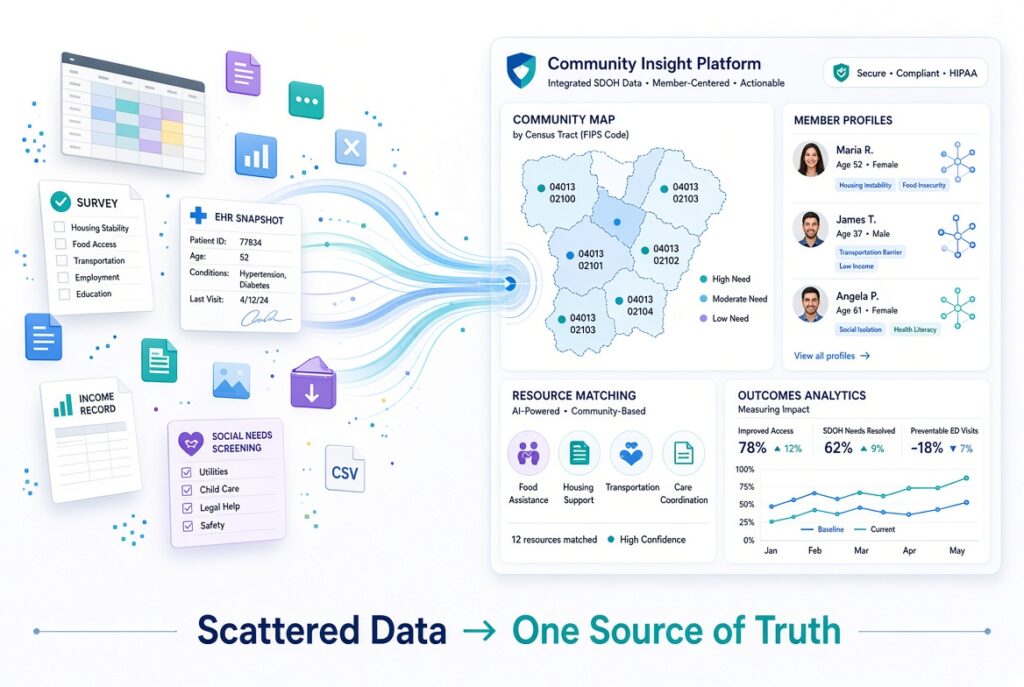
A single source of truth for SDOH data means mapping, member records, referrals, and outcomes live in one connected platform, not in four separate files.
SDOH Solutions brings four capabilities together:
| Capability | What it does | The problem it replaces |
|---|---|---|
| FIPS-code-level community mapping | Shows social needs and available resources by community | Guessing which areas need which resources |
| CRM-lite member management | Keeps member and population records in one place | Separate spreadsheets and survey exports |
| Resource matching and referral tracking | Connects people to community resources and tracks each referral | Manual follow-up by care coordinators |
| Outcomes analytics | Reports on results across programs and communities | Rebuilding reports by hand for each review |
The design principle is simple. Every record connects to a place, every need connects to a resource, and every referral connects to an outcome. That chain is what makes the data usable for planning, not just for storage.
How it works
Moving from scattered files to one platform follows five steps:
- Bring existing data in. Start with the spreadsheets, survey exports, and EHR fields your team already uses.
- Map it to communities. Needs and resources are organized at the FIPS-code level, so your team can see which communities face which barriers.
- Manage members in one place. Member records and care coordination notes sit in the CRM-lite view, replacing the parallel tracking sheets.
- Match and track referrals. Coordinators match people to community resources and follow each referral through to completion without a separate tracker.
- Report on outcomes. Analytics connect needs, referrals, and results so leaders can see what is working and where gaps remain.
The working view is population-level. Teams look at communities and programs, which also keeps planning conversations in community-level language.
What to measure
The clearest test of a single source of truth is whether your team spends fewer hours preparing data and more hours acting on it.
Baseline these measures before you change anything, then review them on a regular schedule. Use your own numbers. Any figure in a business case should come from your organization’s data, not from a benchmark.
| Measure | What it tells you | Outcome it supports |
|---|---|---|
| Coordinator and analyst hours on data prep per reporting cycle | How much time scattered data costs | Hours saved on data wrangling |
| Time from identifying a community need to launching outreach | How fast the team can act | Faster, better-targeted outreach |
| Referrals tracked through to completion | Whether referrals close the loop | Fewer missed handoffs |
| Time to produce value-based care and quality reports | How hard reporting is today | Hitting VBC and quality metrics |
| Community-level trends in utilization, such as ER visits and readmissions | Whether social needs work shows up in results | Fewer avoidable ER visits and readmissions |
The last measure is slower to move and is influenced by many factors, so treat it as a trend to watch, not a promise. The first four are things a team can see change within a few reporting cycles.
Frequently asked questions
What is a single source of truth for SDOH data? It is one connected platform that holds community mapping, member records, referrals, and outcomes together, so every team works from the same data.
Why is SDOH data hard to use when it is scattered? Because each source has its own format and geography. Teams spend hours matching and cleaning data before they can answer a planning question.
What does FIPS-code-level mapping add? It organizes social needs and resources by community, so leaders can see which areas need which resources instead of working from county-wide averages.
Who is SDOH Solutions built for? Health plans and payers, FQHCs, clinics, provider organizations, and the population health, care management, health equity, and value-based care leaders who run them.
How do I get started? Request a free demo and see the mapping, referral tracking, and analytics on your own community questions.
See it in action
If your team is still answering “where does our SDOH data live?” with “a few places,” request a free demo of SDOH Solutions and see what one source of truth looks like for your communities.
SDOH Solutions is based in Houston, TX.
